Last reviewed: November 27, 2026
By Ethan Miller · Read time: 8 minutes
Key takeaways
- Padel is usually doubles on an enclosed 10 m by 20 m court; tennis commonly uses an open court with singles and doubles dimensions.
- Padel uses a solid perforated racket and legal wall rebounds; tennis uses a strung racket and an open boundary.
- Both sports traditionally use love, 15, 30 and 40 scoring, but formats vary.
- “Easier” depends on prior racket skills, movement, fitness and comfort with walls—not on one universal ranking.
Court and walls
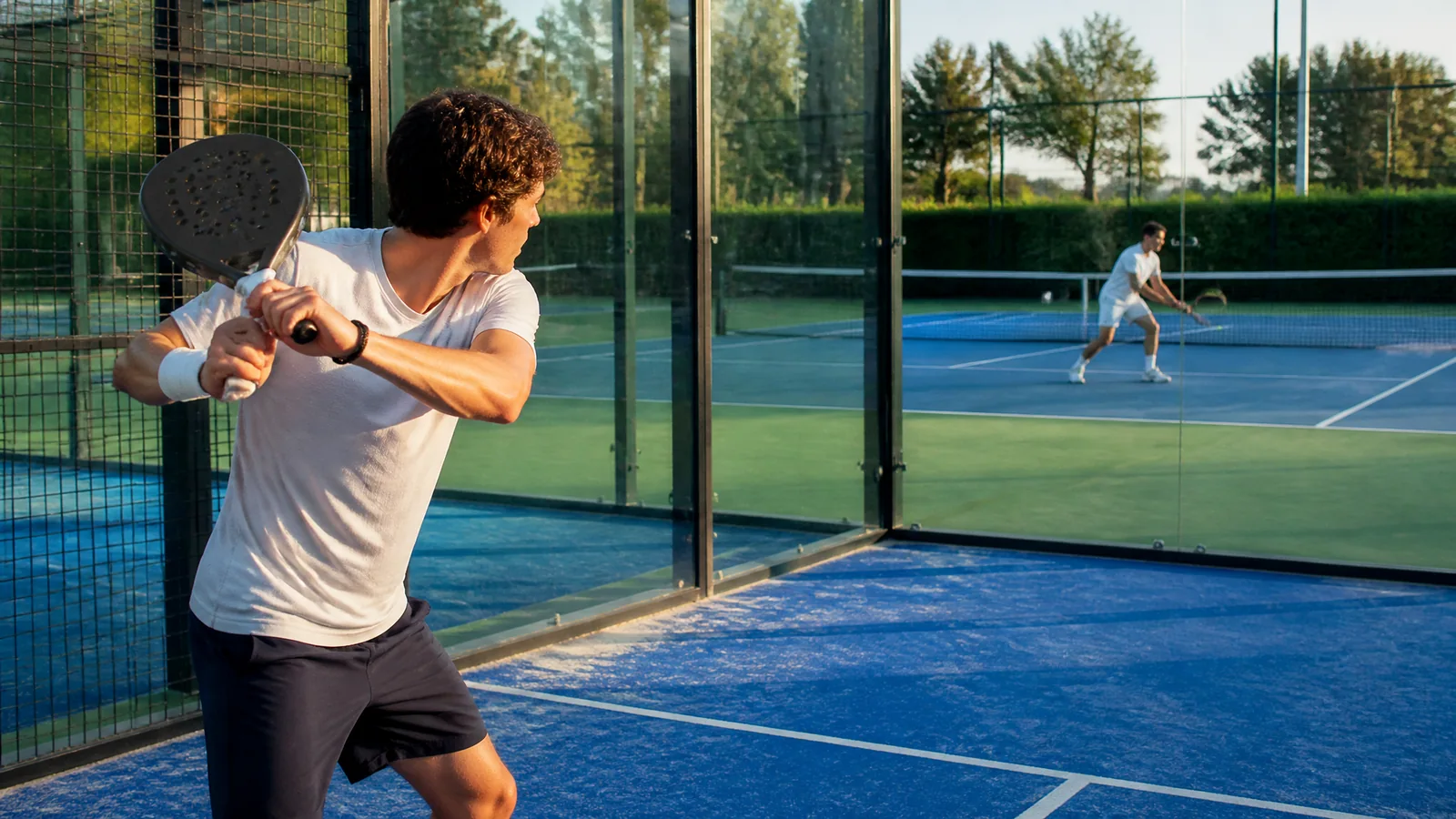
An official padel court measures 10 m by 20 m inside the enclosure. Glass and mesh walls surround the playing area, and the ball can rebound from a wall after a legal bounce. Players normally share the court in pairs. That compact, enclosed environment rewards communication and positioning.
Tennis courts are larger and open. A singles court is narrower than a doubles court, and players must cover the baseline, service boxes and sidelines without using walls as active playing surfaces. Tennis therefore creates more open space and often a longer movement pattern, although both sports can be physically demanding.
Rackets and balls
A padel racket is solid and perforated, with no strings. Its shape, foam and balance influence control and power. A tennis racket has a strung hitting surface and comes in a wider range of head sizes and string setups. Padel balls resemble tennis balls but are not simply interchangeable in every context; pressure and event specifications matter.
The different equipment changes contact. Padel encourages compact swings, blocks and controlled rebounds. Tennis often rewards a longer swing path and more pronounced topspin or slice mechanics. A tennis player can transfer timing and footwork, but should not swing every padel ball as if the walls were out of play.
Serve and scoring
Padel’s standard serve is underarm, diagonal and struck after a bounce, subject to the current rulebook’s position and height requirements. Tennis serves are struck without the same underarm bounce requirement and can involve an overhead motion. In both sports, service placement sets the point’s tactical pattern.
Traditional scoring uses love, 15, 30 and 40 in both sports, but competitions may use tie-breaks, advantage or alternative formats. Padel players should read FIP rules for the event; tennis players should read the relevant governing-body regulations.
Movement and tactics
Padel’s first tactical lesson is moving with a partner. A pair tries to maintain a connected defensive or attacking line and manage the middle. Lobs, wall rebounds and soft shots can be more valuable than raw pace. Players also need to judge whether to take the ball before or after the glass.
Tennis is usually a one-player coverage problem in singles or a broader formation problem in doubles. Serve-plus-one patterns, baseline exchanges and net approaches can create large changes in court position. There is no universal intensity comparison: a relaxed padel game can be easier than a competitive tennis match, while a fast padel rally can be highly demanding.
Which is easier?
Many beginners find padel approachable because the serve is underarm, the court is compact and doubles gives immediate social structure. The walls, however, introduce a new reading skill, and repeated accelerations still require conditioning. Tennis can feel familiar to people with strong hand-eye coordination, but serving and covering an open court can be difficult at first.
Try both at a beginner pace. Tell the coach your background, use suitable footwear and measure success by learning a repeatable shot rather than winning immediately. Our beginner rules guide covers a first session. Use the Courts directory for local discovery as verified venue listings become available.
Side-by-side decision table
| Question | Padel | Tennis |
|---|---|---|
| Typical format | Doubles on an enclosed court | Singles or doubles on an open court |
| Racket | Solid, perforated face | Strung face |
| Serve | Underarm, after a bounce, diagonal | Usually struck without an equivalent bounce requirement |
| Ball in play | Legal wall rebounds are central | Walls are boundaries, not normal playing surfaces |
| Early tactical priority | Pair movement, lobs and safe wall decisions | Coverage, depth, serve patterns and open-space management |
| Common beginner challenge | Reading rebounds and staying connected | Timing the serve and covering a larger open area |
This table is a learning aid, not a substitute for the current rules. Equipment and formats vary, and a short social session may not resemble a competitive match.
What transfers from tennis—and what does not
Tennis players usually bring useful hand-eye coordination, split-step awareness, ball tracking and an understanding of a rally’s geometry. They may also recognise the traditional point calls. Those skills reduce the novelty of the first lesson, but they do not remove the need to learn the padel wall.
The biggest adjustment is often swing length. A padel racket is shorter in feel and has no strings to create the same response. Compact preparation helps when the ball arrives quickly at the net. A tennis player also needs to stop assuming that a ball travelling toward the glass must be taken immediately; waiting for the rebound can create a better contact point.
Padel players moving to tennis face a different set of changes. The open court creates more space to cover, the serve becomes a larger technical event, and a strung racket can reward a longer swing. A player who is effective with a defensive lob in padel may need to adjust height, depth and spin for tennis conditions.
Difficulty depends on the objective
For a first social rally, padel can feel accessible because the underarm serve and doubles structure produce early exchanges. For a formal match, wall reading, rapid transitions and partner coordination add complexity. Tennis can be demanding from the first serve but offers familiar solo practice patterns for some players.
For fitness, compare like with like: session duration, level, rest, court size and effort. Avoid claims that one sport is always better. Someone with an injury, low current conditioning or a long break should increase workload gradually and seek professional advice where needed.
Choosing your first session
Choose padel if you want a social doubles introduction, enjoy solving rebounds and have access to a suitable enclosed court. Choose tennis if you prefer an open-court format, singles practice or the technical challenge of a full serve. Trying one does not require abandoning the other.
Before either session, ask what equipment is provided, what shoes are accepted and how the coach handles mixed levels. The beginner padel guide covers a first lesson, while the London courts page can be used only after its venue information is published and verified.
A fair first-session comparison
To compare the sports fairly, keep the session goals similar: a short warm-up, basic instruction, cooperative rallies, a few points and a cool-down. Do not compare an introductory padel lesson with a competitive tennis match and then make a general claim about difficulty. Note how much explanation you needed, how your body felt the next day and which skill you wanted to practise again.
The best choice may also change with your social group, local access, budget and available coaching. Those practical factors are part of the sport experience even though they cannot be reduced to a court diagram. Choose the session you can attend consistently and enjoy safely.
FAQ
Is padel easier than tennis?
It may be easier to start socially for some players, especially because of the underarm serve and doubles format. Walls and quick movement create their own learning demands.
Can a tennis player switch to padel?
Yes. Tennis timing, footwork and anticipation transfer, but the player must shorten swings, learn wall rebounds and coordinate with a partner.
Are padel and tennis balls identical?
They are similar but can have different specifications. Use the ball required by the venue or competition.
Which sport is better for fitness?
Both can provide substantial exercise. Intensity depends on match length, level, movement and rest, so do not make a universal fitness claim.
Sources and internal links
- FIP, Rules of Padel PDF: https://www.padelfip.com/wp-content/uploads/2025/12/FIP_Rules-of-Padel.pdf (checked 27 November 2026).
- FIP Documents: https://www.padelfip.com/documents/ (checked 27 November 2026).
- links: `/guides/`, `/how-to-play-padel/`, `/courts/`.
CTA: If you already play tennis, book a beginner padel session and spend the first half learning walls and spacing before trying to hit winners.