Last reviewed: November 27, 2026
By Ethan Miller · Read time: 8 minutes
Key takeaways
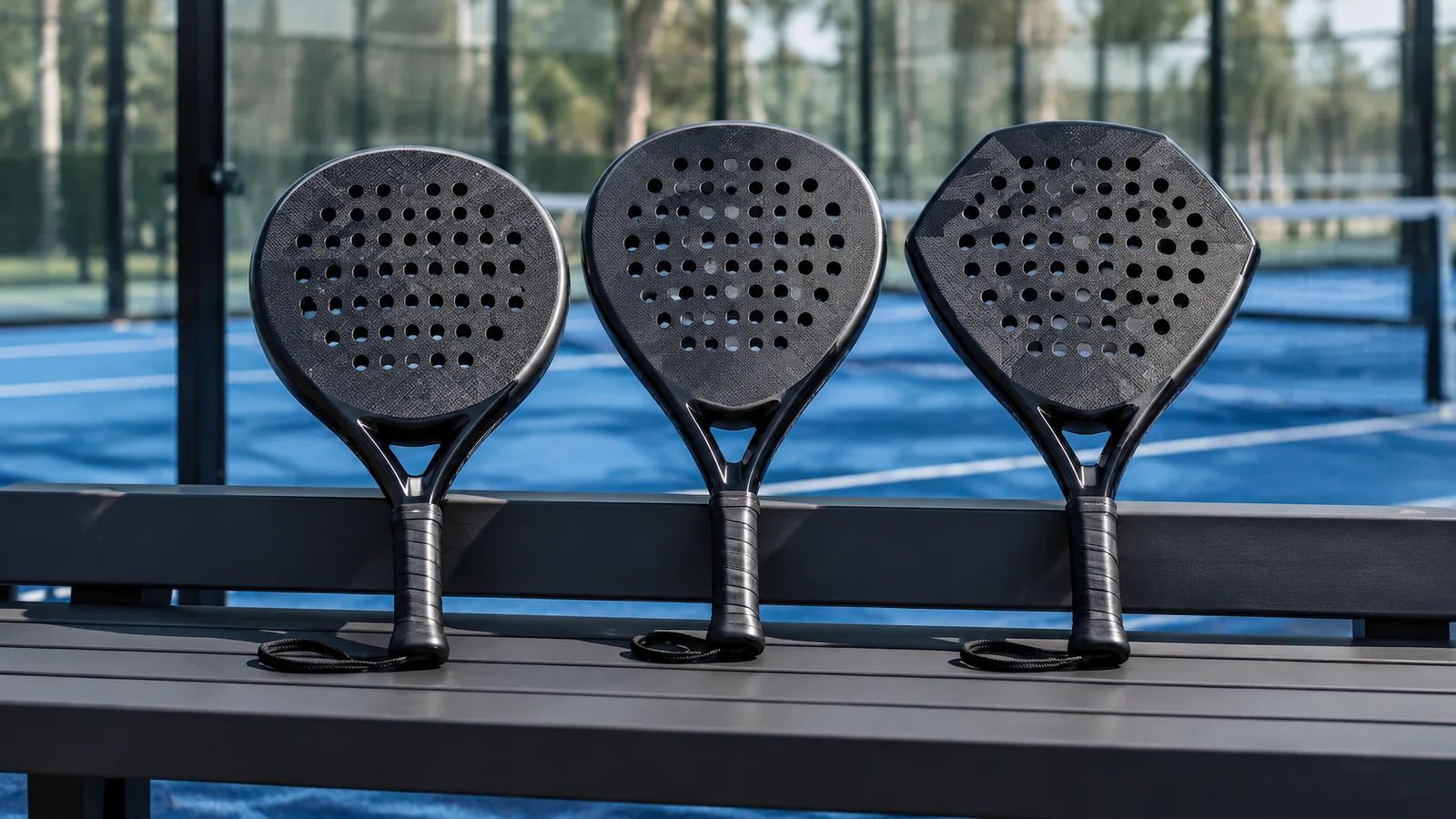
- Round usually prioritises forgiveness and easy handling.
- Teardrop is a broad middle category, not a guarantee of perfect balance.
- Diamond commonly puts more mass high in the head and rewards confident technique.
- Foam, weight, balance and grip can outweigh the shape label.
Why shape matters
Racket shape influences where the face is widest, where the balance tends to sit and how much of the face feels useful when contact is not perfect. It does not dictate your technique. Two rackets with the same silhouette can feel very different because manufacturers use different cores, face materials, thicknesses and weight distributions.
Padel rewards preparation and placement. You will defend against glass, block at the net and hit overheads, often while moving. The right shape is therefore a fit question: can you present the face early, control the ball and recover for the next shot?
Round rackets
The round outline is often the safest first comparison. Its central hitting area can feel generous, and many round rackets have an even or lower balance that helps a player move the racket into position. That combination is useful for beginners, defensive players and anyone returning after an arm problem—subject to medical advice.
The trade-off is that a round racket may not give the same easy leverage for maximum overhead pace as a head-heavy diamond. That is not a weakness for most recreational points. Control lets you keep the ball low, use the walls and make fewer unforced errors while your technique develops.
Teardrop rackets
Teardrop or hybrid shapes sit between the other two families. Their balance can be even to moderately head-heavy, and they may suit an intermediate player who wants to add pace without giving up all-round handling. Because “teardrop” covers a wide range, check the product’s stated balance and weight instead of assuming every model feels alike.
A tennis player with a reliable swing may find this shape intuitive. A new player should still test whether the racket feels stable on a defensive block and not just powerful on an easy forehand.
Diamond rackets
Diamond designs generally move the widest area and mass toward the top. This can support powerful overheads when the player has timing, preparation and strength. It can also make quick defensive exchanges more demanding, particularly when the ball is low or arrives close to the body.
A diamond racket is not automatically unsuitable for an improving player. It is simply less forgiving when the player’s contact point changes. Choose it because its balance and feel match your game, not because “more power” sounds like a shortcut.
How to decide
Use this quick process:
- **Describe your miss.** Late contact and defensive errors suggest prioritising manoeuvrability; lack of depth may call for technique work before a heavier racket.
- **Check balance, not only shape.** Ask the retailer or manufacturer whether it is head-light, even or head-heavy.
- **Compare the sweet spot.** If you cannot demo, read the maker’s level guidance and return terms.
- **Consider your arm.** Repeated discomfort is a reason to stop and seek qualified advice, not to keep changing rackets randomly.
- **Keep your partner in mind.** Reliable control and placement help doubles strategy more than occasional spectacular shots.
- Head, “How to Choose a Padel Racquet”: https://www.head.com/en_US/rs/stories/how-to-choose-a-padel-racquet (accessed 27 November 2026).
- FIP, official documents and rules: https://www.padelfip.com/documents/ (accessed 27 November 2026).
- links: `/gear/`, `/best-padel-rackets-for-beginners/`, `/courts/`.
Our beginner racket guide explains weight, grip and materials. Use the Courts directory to look for a suitable venue when planning a demo or lesson.
Comparison table in plain English
| Shape | Typical balance tendency | Often suits | Main trade-off |
|---|---|---|---|
| Round | Lower or even | New players, defenders and control-first players | May offer less effortless overhead leverage |
| Teardrop | Even to moderately head-heavy | All-round and improving players | Wide category; individual models vary substantially |
| Diamond | Higher in the head | Strong, confident attackers | Smaller-feeling usable area and more demanding defence |
These are tendencies, not rules. A manufacturer can build a soft diamond racket or a firm round racket, and nominal weight does not tell you how the mass is distributed. Read the full specification and, where possible, compare the actual racket in your hand.
Match shape to the shots you actually play
If points at your level are decided by missed returns, late blocks and balls that arrive near your feet, start with manoeuvrability. A round racket can make it easier to get the face behind the ball and send a safe lob. The improvement comes from a more repeatable contact, not from the outline magically correcting technique.
If you are already comfortable defending and want to add pressure, a teardrop model may make sense. Test whether the extra mass helps on volleys and controlled overheads without slowing your preparation. “All-round” should mean you can execute the whole point, not only hit a faster ball from a stationary position.
A diamond model is most logical when your overhead preparation is reliable, you can contact the ball in front and you do not lose control when rallies speed up. Its potential advantage matters only when you can access it. If you repeatedly arrive late, a more demanding racket can amplify the problem and fatigue your arm.
A repeatable demo protocol
Use a simple side-by-side session. Begin with shadow swings, then play ten cooperative balls from the back of the court. Move to defensive blocks at the net, followed by lobs and one or two overhead patterns. Rate each racket from one to five for preparation, stability, depth control and comfort. Do not award extra points for a single spectacular shot.
After five minutes, switch rackets without changing your position or drill. If one feels much heavier, check whether it has a different overgrip or protector before drawing a conclusion. A demo cannot reveal every durability question, but it can show whether the balance matches your movement.
Shape is not a substitute for tactics
A player who hits every ball hard may blame a round racket for a lack of power when the real problem is contact point or footwork. A player who buys a diamond racket may still lose points if the pair stays split at the back. Use equipment to support a sound plan: serve with margin, return safely, move with your partner and choose the wall when it gives you time. If your miss pattern changes after a coaching adjustment, reassess the racket rather than treating the first diagnosis as permanent.
For a first purchase, our beginner racket guide covers grip, materials and care. Use the courts directory for a demo or lesson only when the actual venue information is live and verified.
FAQ
Which shape has the biggest sweet spot?
Round rackets are commonly designed with a more central, forgiving hitting area, but sweet-spot size is not determined by outline alone. Construction and foam matter.
Do diamond rackets hit harder?
Their higher balance can help a technically sound player create leverage. It does not guarantee more speed, and it can make timing and defence harder.
Is teardrop the best all-round shape?
It can be an effective compromise for some intermediate players, but individual balance, weight and feel are more informative than the category name.
Can I use a round racket in competition?
Yes, provided the racket complies with the applicable competition rules and equipment requirements. Shape is not a beginner-only category.
Sources and internal links
Affiliate disclosure: Gear links may be affiliate links. Any commission does not change the editorial criteria. Prices, stock and product specifications should be checked on the linked retailer or manufacturer page at the time of purchase.
*Next step:* Borrow or demo one racket from each category and hit defensive blocks, volleys and a few overheads—not just a single smash.